
The 272: The Families Who Were Enslaved and Sold to Build the American Catholic Church
A book by Rachel Swarns
A summary of the book with related information and resources prepared for the Southern Maryland Equity in History Coalition website by Hugh Davies
This is the story of the nearly 300 enslaved people who were sold by a group of America’s most prominent Catholic priests in order to fund what would become Georgetown University. It is an important book for those seeking to understand the full history of Southern Maryland for the following reasons:
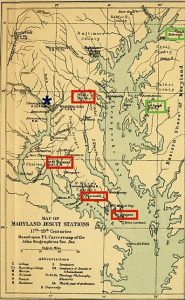
- The book centers on places and past significant events here in Southern Maryland. It describes the treatment of the enslaved at four of the five plantations belonging to the Jesuits – St. Inigoes and Newtown Neck in St. Mary’s County, St. Thomas Manor in Charles County, and White Marsh in Prince George’s County. It is our history. Descriptions of the four plantations are included in this website.
- It is a true story – of The 272 (referred to as the GU272+) – of how Jesuit priests who owned the five plantations “sold south” the 272 + enslaved people in order to obtain the funds to financially save Georgetown College (later Georgetown University) and build the American Catholic Church.
- The book serves as one significant example of the enslaved in the mid-Atlantic being “sold south”. The enslaved deeply feared being “sold south” due to slavery conditions being far worse than in Maryland. For many it was death sentence, as life expectancy on arriving in the South was only seven years. After the importation of the enslaved was prohibited in 1808, upwards of one million enslaved were forcibly moved from the mid-Atlantic states to the deep South. Often families were torn apart, never to contact each other again.
- It is also the story that continues today of descendants who are seeking to locate their ancestors, relatives and histories. It is also about determining what should be the appropriate reconciliation and reparations between Georgetown (and the Jesuits and Catholic Church) and the GU272 descendants.
The book, The 272, follows one family through nearly two centuries. It begins with Ann Joice who arrived in St. Mary’s in 1678 as a free but indentured woman. However, her indentured master burned her papers and declared her a slave. Throughout her life, Joice always adamantly maintained that she was actually an indentured servant, because she came to Maryland through England, which no longer had slavery. She vociferously related her story to family and friends throughout her lifetime. So begins the lineage of the Mahoney family – the enslaved descendants of Ann Joice – whose story is at the center of GU272. These descendants continued to argue in the courts that they should be free because Ann was originally free. Few were successful.
Life for the Mahoney’s at St. Inigoes
The St. Inigoes Planation is located at the southeastern end of St. Mary’s County. It was part of the first settlement in Maryland at St. Mary’s City. The Calverts gave the land for the plantation to the Jesuits in 1637. St. Ignatius Church, on the property, is the oldest continuously operating Catholic Church in English speaking North America. The Jesuits had three other plantations in Southern Maryland and one on the Eastern Shore. The Jesuits realized that in order to make the tobacco plantations productive they would need slave labor. Ann Joice’s descendants, the Mahoney’s were among the enslaved at St. Inigoes.
During the War of 1812, British ships occupied the Chesapeake and the Patuxent and raided the plantations along the rivers. Father Joseph Carbery, priest in charge at St. Inigoes, was a firm manager, he also treated the enslaved fairly. When the British invaded the plantation, Father Carbery and the enslaved fled. Harry Mahoney helped by carrying the plantation’s funds away and burying them so the British could not find them. He also protected the enslaved women. Father Carbery was grateful to Harry and pledged that Harry and the Mahoney family would not be “sold south”. Most all enslaved had a deep fear of being “sold south”, as it meant far harsher working conditions and the prospect of families being split apart.
During the ensuing years leading up to 1838, the Jesuit leadership encountered financial strains in building Georgetown College. They recognized that the enslaved represented a major financial resource, and that selling them could effectively generate the funds to save the college and preserve the future of the Catholics and the Jesuits in the United States. There was extended debate among the Jesuits about doing this – from both a moral and practical standpoint. Ultimately the Jesuit leadership needed to receive approval from Rome, which it received in 1838. Rome’s approval of the sale came with conditions, including that families must remain together and that the enslaved would be able to continue to practice their faith. Father Carbery was against the sale, and upon learning of the decision he returned to St. Inigoes. The author Rachel Swarns on page 109 describes the following,
“He (Father Carbery) seemed quiet and downcast as he sat down at the dinner table. Harry Mahoney, the patriarch of the Mahoney family, who had saved the estate’s young women and valuables during the War of 1812, was serving his meal. But Carbery couldn’t eat. Harry knew it then, “We’re sold!” he cried.”
Being Sold South and Life Afterward
The sale by the Jesuits was to former Governor of Louisiana Henry Johnson. After the decision, the Jesuit leadership and the buyers visited the plantations to make the arrangements for the sale. The final sale terms were for 272 enslaved to be sold for $115,000.
The sale documents only included first names of most of the enslaved, but they included the family names of the Queens, the Goughs, the Hawkinses, the Campbells, the Butlers, the Browns, the Dorsey’s, the Wests, and the Mahoney’s. Within days of the agreement, the buyer hired a man to take charge of rounding up the enslaved. He and his men swept through the St. Inigoes plantation taking frantic families – forty-one people in all. Father Carbery urged the enslaved to run, and Harry’s daughter Louisa did so. By that time, Harry was too old to take. Sister Anny and her two children were taken as part of the forty-one from St. Inigoes.
The enslaved were transported by boat to Alexandria, Virginia and held in the Franklin and Armfield Slave Trading Compound. There they awaited transportation by boat – the Katherine Jackson – which held 130 of the Jesuit enslaved. It would be a three-week trip in horrid conditions to New Orleans. There they were held and then transported by boat to the Marengo plantation owned by Johnson. All members of a family were expected to be in the fields tending the cotton at a fierce pace. They survived over the coming years – Annie’s children married and had families of their own through the time of the Civil War. On becoming free they left the plantation and settled in New Orleans.
Back at St. Inigoes, Father Carbery was able to shelter the remaining Mahoney family, including Anny’s sister Louisa and others. They continued to live peaceably on the plantation but knew nothing of what had happened to their relatives who had been sold. Louisa knew nothing of what had happened to Anny and her two children. After the Civil War and freedom, Louisa decided to stay on at St. Inigoes.
Reconciliation and Reparations with Georgetown University
The funds realized from the sale allowed Georgetown and the Catholic church to survive and thrive. They supported new colleges throughout America and Gonzaga High School in Washington, DC. After considerable research, author Swarns published in 2016 a front-page article in the New York Times about the sale. This initiated responses from Georgetown University, the Jesuits, and the descendants. The University’s initial response was to apologize and offer descendants preferential consideration in admission to the university. This modest initial response has continued to expand. The descendants came together to form an organization and made recommendations to the university including a request for a One Billion Dollar fund. That has not been realized, but in 2021 the Jesuits and Georgetown did pledge $100 million to benefit the descendants.
An Individual Case of a Descendant.
Mélisande Short-Colomb began her relationship with Georgetown University in 2017 as a descendant of two families enslaved “sold south” by the Jesuits in 1838. A native of New Orleans, LA, she retired from a lengthy culinary career, most recently as Instructor for Langlois Culinary Crossroads. Her ancestors, the Mahoney and Queen families, were among the 272. Following the Working Group on Slavery, Memory, and Reconciliation recommendations and with the support of President Jack DeGioia, Mélisande became one of two undergraduate students accepted into the College. There she has developed an ongoing relationship with the Laboratory for Global Performance & Politics. Meli has written, and performed a one person show titled, Here I Am. She describes the performance as:
“Our ancestors have waited patiently through centuries for us to come to the table of acknowledgement. Here I Am fulfills my desire to give voice to those families, including my own, and to our tenacity and strength as a people … to close the full circle where we began our American lives three centuries ago and where we are today.”
Melisande was the keynote speaker for the launch of the Southern Maryland Equity in History Coalition on May 1, 2024 at St. Mary’s College of Maryland.
A Gathering of Descendants in Southern Maryland.
For four days beginning August 2, 2023, the Southern Maryland GU272 Enslaved convened the “Celebrating Faith, Family and Unity” Reclamation Project. The event organized by Julie Hawkins Ennis drew hundreds of people with events taking place at St. Mary’s College of Maryland, St. Peter Claver Church, and across the region. see Descendants of people enslaved and sold by the Jesuits in 1838 reunite for family reunion in Southern Maryland – Catholic Standard
In closing, author Swarns shared, “Slavery is more than just history, it lives with us, all of us, now. Schools, churches, and many of our most influential institutions are still deeply entwined with the legacy of racial injustice, and we need to grapple with that history to find our way forward.”
Additional Resources
Information on GU272 in the Southern Maryland Equity in History Coalition’s website:
Background on Ann Joice – Ann Joice – Southern Maryland Equity in History Coalition
Other cases and examples of the enslaved being “sold south”:
- Charles Ball Charles Ball – Southern Maryland Equity in History Coalition
- Isaac Brown 0e4716292_1449286693_continuing-on-the-trail-of-souls.pdf
Information on the four plantations:
St. Ignatius Church at St. Inigoes – Southern Maryland Equity in History Coalition
St. Thomas Manor and St. Ignatius Church – Southern Maryland Equity in History Coalition
Newtowne Manor and St. Francis Xavier Church – Southern Maryland Equity in History Coalition
On the timeline:
Georgetown University sold its slaves – Southern Maryland Equity in History Coalition
Other Resources
The GU 272 Memory Project GU272 Memory Project
http://slaveryarchive.georgetown.edu/
An excellent set of resources and organizations SMR: Descendants | Georgetown University Library
Jesuits: What we have learned What We Have Learned – Jesuits.org
Our Response to Jesuit Slaveholding – Jesuits.org
Her I Am, play by Mélisande Short-Colomb, a GU272 descendant.